
In the run up to the May elections, we are running Love Epping Forest Manifesto to put Epping Forest on the agenda. We are asking candidates to commit to delivering nine pledges over the next four years. The pledges have come out of our research and extensive engagement work with the Forest’s local communities.
Below you can read about the evidence base for the pledges and concreate suggestions on how local councillors can action them. This article focuses on the three pledges that are centre around one of the three key themes: Keeping the Forest Safe and Accessible.

The A104, or Epping New Road, bisects Epping Forest, is recognised by the Department for Transport as one of the most dangerous roads in England
Pledge 7:
[London:] Keep Forest visitors safe and increase Forest accessibility by lowering speed limits for all roads within and around to Forest to 20mph
[Essex and EFDC:] Keep Forest visitors safe and increase Forest accessibility by lowering speed limits for all roads within and around the Forest to 30mph
We maintain that these changes are essential to ensure that Forest visitors stay safe and the Forest itself becomes more accessible.
In Essex, a reduction of speed limit from 40mph to 30mph for roads in/around the Forest would have a huge impact.
The A104/Epping New Road, the subject of our “Make Epping New Road Safe Campaign,” is a good example. The public survey data we collected through our Make Epping Road Safe Campaign is telling:
- Drivers scored their current comfort levels driving down Epping New Road at 5.9/10, while the pedestrian score for comfort crossing the road was a shocking 3.2/10.
- By contrast, in response to our proposed 30mph speed limit on the road, pedestrian comfort scored at 7.1/10, and driver comfort with the extra journey time at 8.7/10.
The research clearly supports public intuition. Our Campaign hinged on research showing a reduction in risk of collision and 3.5-5.5x reduction in risk of fatality from collisions between pedestrians and vehicles going at 30mph as opposed to 40mph.
Testimonials from the campaign talked about the difficulty which Epping New Road specifically, and the roads around Epping Forest generally, pose for families, school groups and people with mobility issues.
These issues are also relevant to other parts of Epping Forest’s surrounding road networks in London. Rangers Road also cuts through the Forest between Chingford Plain and Barn Hoppitt, posing similar issues for safety and accessibility. The Forest’s fragmented nature raises many more localised issues of Forest transit across London. Roads, including A Roads, become inevitable obstacles for people trying to make their way between Knighton Wood, Reed’s Forest, Woodford Green, George Green and many other small pockets of ancient Forest land.
Plenty of research backs this further decrease in speed limit to 20mph which we’re proposing for all London roads around the Forest (1).
We want councillors to support these changes, to enable people to feel safer and more confident to visit more of the Forest.
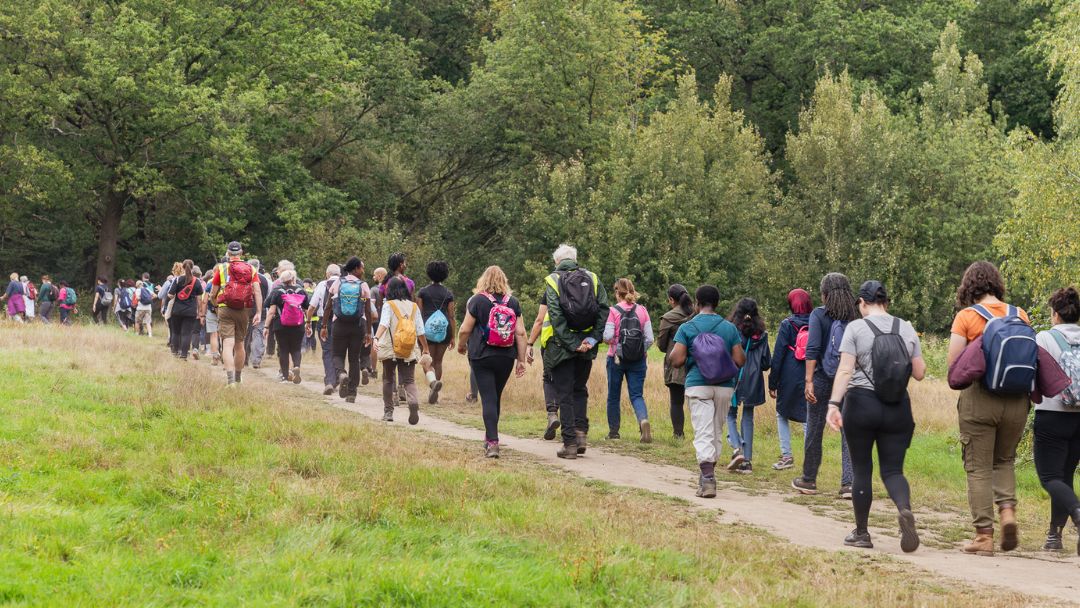
The annual Epping Forest Big Walk encourages people to walk from Manor Park in East London to Epping in Essex and experience the Forest in one day.
Pledge 8: Promote greater access to the Forest for all residents in my local area through a range of accessible, safe and sustainable transport modes – walking, cycling and public transport
Walking and cycling are sustainable modes of transport which bring with them great mental and physical health benefits. Supporting a modal shift towards these would also help councils relieve over-taxed road networks (EFDC have said that their road networks are at full capacity) (2).
Increased public transport in/around the Forest would achieve similar affects, in terms of reducing cars on the road and minimising pollutants. Options available to councils include a summer bus service. These services, operating along Forest roads and connecting the parts of the Forest which are often thought of as inaccessible without a car, like High Beach, used to exist, and in fact were suggested by the most recent Epping Forest Sustainable Transport Strategy.3
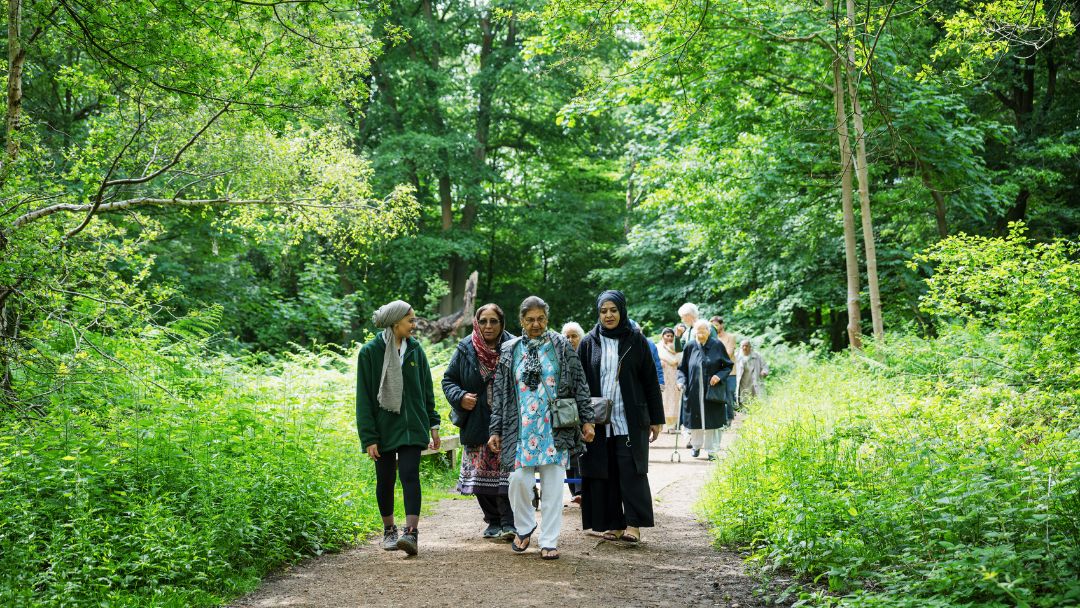
Behnu-Ki-Milan, a mixed faith group of older, Asian women based in Newham enjoyed a Forest day out with guided walk and block printing. June 2024. Photo: Locality/Alex Brenner
Pledge 9: Ensure a greater diversity of people can access the health and well-being benefits of the Forest through initiatives such as community engagement and social prescribing
Epping Forest is a place where people can wander, rest and reflect. We want councillors to ensure that as much of a diversity of communities as possible can enjoy these moments.
The relevance of Forests and other natural spaces to physical and mental wellbeing is well-documented, as is the relationship between nature-connectedness and wanting to conserve the natural world. (4)
Recently, a notion of “Heritage connection” has also been proposed. With a person’s relationship with local heritage comes a heightened sense of belonging and wellbeing, along with a drive to protect that local heritage. (5)
Through our community engagement work with groups like Muslim Hikers and Black Girls hike, we have experienced first hand the joys that come with introducing people to Epping Forest. Many participants have become motivated to support us with more community engagement work, alongside our practical conservation and policy work, bringing their love, commitment and unique skills with them.
However, nature and heritage connectiveness cannot be taken for granted. Research indicates that human connection to nature has declined by 60% over the last 200 years (6). Moreover, on a local level, connection to Epping Forest’s nature and heritage is not equitable. Waltham Forest Visitors Survey shows that the percentages of black and Asian residents who visit the Forest weekly is 13% and 9% less than that of white residents, and the percentage of women who visit is 8% less than the percentage of men.
Social prescribing provides an opportunity for local councils to inform more local people about the Forest and encourage them to visit.
Social prescribing is a service, provided by local NHS groups, that connects people to activities, groups, and services in their community to meet the practical, social and emotional needs that affect their health and wellbeing.
Waltham Forest, Redbridge, Newham and Epping Forest District Council all recognise the importance of social prescribing in their Health & Wellbeing Strategies. We urge local councillors to continue this good work and promote Epping Forest as a key part of it. Alongside promoting and supporting community engagement initiatives like those delivered by the Trust, social prescribing is a great way for councillors to connect their constituents with Epping Forest and nurture a borough/district-wide drive to protect the Forest.
References:
- 2024, The Benefits of 20mph in London
- 2023, EFDC Local Plan
- 2009, Epping Forest Transport Strategy: proposals 2009-2016
- 2023, Psychological and physical connections with nature improve both human well-being and nature conservation: A systematic review of meta-analyses – ScienceDirect
- 2025, Heritage Connection: Scoping and Sounding the Field
- 2025, Modelling Nature Connectedness Within Environmental Systems: Human-Nature Relationships from 1800 to 2020 and Beyond

Protecting Nature and Wildlife (pledges 1-3)
Read about the evidence base for the pledges 1-3, centred around the theme ‘Protecting Nature and Wildlife’.
Working Together for the Forest (pledges 4-6)
Read about the evidence base for the pledges 4-6, centred around the theme ‘Working Together for the Forest’.

Love Epping Forest Manifesto
Find out more about our 2026 election awareness campaign, the pledges we are asking candidates to commit to, and ways that you can help.