
Last updated: November 2026
A People’s Vision for the People’s Forest, launched at our 2026 AGM, will mark an ambitious exercise of “future thinking”, where we will ask local communities to imagine and discuss hopes and concerns for what Epping Forest will be like in 2078: the 200th anniversary of the Epping Forest Act.
Epping Forest represents a unique blend of nature, heritage and culture, and we aim for our project to reflect this. Nevertheless, we can also look to similar, past projects from around the UK to gain inspiration and insight; ground has been covered by organisations whose concerns range from government, cities, museum heritage and natural heritage.
Below, we’ve reviewed six of these future thinking projects, looking at their methods and outcomes to see what we can learn.
1. “London Futures Review” Centre for London, 2020-2021
The London Futures Review, led by Centre for London, explored how the city has evolved, the challenges it faces and its potential futures. It involved three stages: an initial report – “London at the Crossroads” – analysing London’s development and developing five future scenarios; public and stakeholder engagement, including polling, an interactive platform with over 1,000 responses and five expert roundtables; and a final report setting out targets for 2030 and aspirations for 2050.
The London Futures Review is a great example of attaining and evaluating community-led priorities in the face of London’s many evolving challenges. Priorities for the future centred around affordability, access to public spaces and pro-nature approaches to transport and infrastructure.
London, and how it will change over the next 50 years, will have major implications for Epping Forest, and so these considerations, and this approach to listening to community voices, will play a key role in our work over the next year.
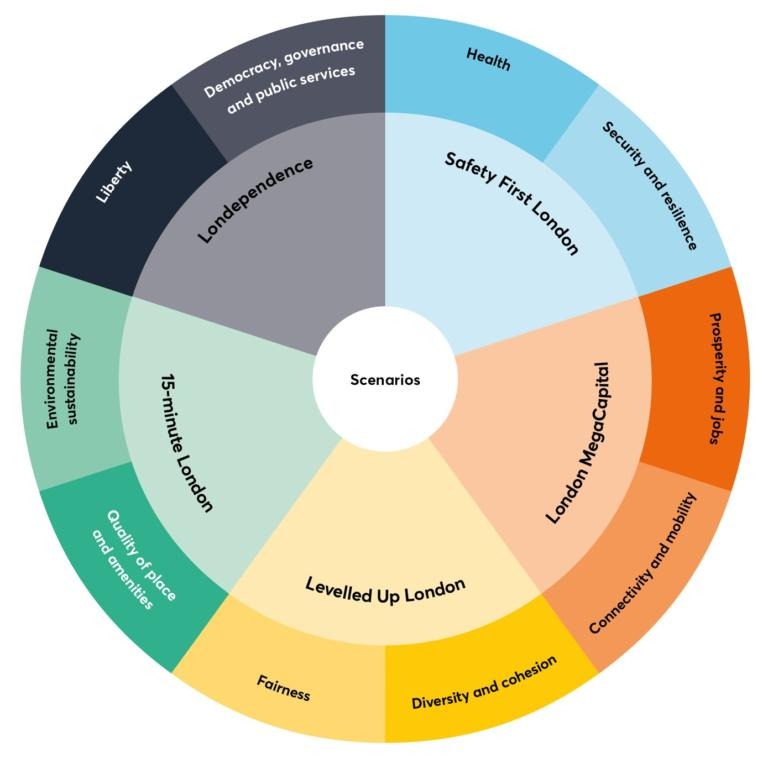
Five potential future scenarios set out in the London Future by Centre for London. Image source: Centre for London
2. “Future Forest: The Black Wood of Rannoch“ Forest Research, Landscape Research Group & Collins & Goto, 2013-2015
This was a future thinking exercise to recover lost cultural values, create new meanings and imagine alternative futures for the Black Wood. The project included a variety of methods of data collection and engagement with the public, including forest walks, public debates, and a two-day “future forest” workshop.
Conversations focused on the speculative, including discussions on the tensions between the local public interest and the Forestry Commission, and more specific positions about management of the forest. Amongst what emerged were new approaches to paths and car parks and proposed initiatives for establishing a combined ecological, arts and humanities residence programme to recover and reclaim forest culture.
This project captures the breadth of what an ancient woodland can represent: a place of incredible natural and heritage value, with ongoing cultural significance. Similarly, we aspire to capture the many things Epping Forest can and does represent for people.
Read the full publication of Future Forest: The Black Wood of Rannoch
Cover page of the publication Future Forest: The Black Wood of Rannoch. Source: Collins & Goto
3. “Nature and Us” Natural Resources Wales, 2022
This was a national future thinking initiative, focusing on what the environment in Wales should look like in 2050 and what changes are needed before then. Five Outcomes, Ten Actions and Five Themes through which the Actions could achieve the Outcomes were arrived at through the research.
Like in the London Futures Review, visions for the future centred around eco-friendly transport and access to green spaces (and particularly on making that access equitable). Emphasis was also placed on governance and ensuring that communities can play a key role in decision-making.
We are inspired by the range of engagement methods the Welsh government used, including public surveys, webinars, workshops and public focus groups. To gain a good spread of insight and make sure that discussions can be had at a good level of depth, we intend to provide a similar array of surveys, workshops and other public events.
The Nature and Us / Natur a Ni identity was developed to be inclusive, encourage participation in the national conversation and reinforce the link between society and the natural environment. Source: Natural Resources Wales
4. “Preserving Pasts | Imagining Futures” National Galleries Scotland & National Library of Scotland, 2021
During this project, staff from the two organisations selected objects from the organisations’ collections which depicted five landscapes around Scotland. Visitors were then encouraged to create their own artistic response to imagine how these Scottish landscapes could look in the future. Submissions included photography, collage and drawings. We also believe that other creative practices can contribute to our imaginative exercise.
In the new year, we’ll host workshops where people can creatively express their vision for the future of the Forest. We also aim to build this creative expression into our later engagement work, to help provoke further thought during roundtable discussions.
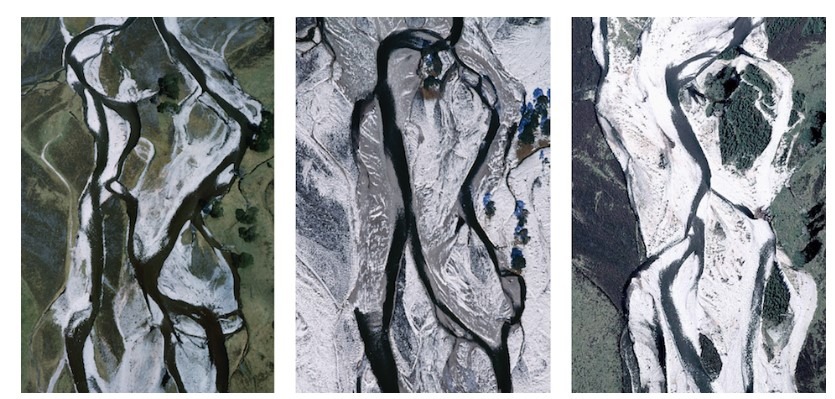
Patricia and Angus Macdonald, Braided river and Caledonian pines, Glen Feshie, Cairngorms, Scotland, 57° 00’ 25” N, 3° 54’ 15” W (triptych): [left to right] #1: 1988; #2: 1995; #3: 2016, from the ongoing, long-running projects The Unwild and Re:Wild photographic colour giclée prints on Hahnemuhle paper. © Patricia + Angus Macdonald. Source: National Galleries Scotland
5. “Community Conversations: How Warrington Youth Shaped a Vision for a Greener Future” Warrington Council, 2024-2025, and
6. “Hopeful Futures: Londoners’ Visions for a City that is Well-Adapted to Climate Change” KCL Policy Institute & London Boroughs of Lambeth, Southwark and Tower Hamlets, 2026
These are two local authority-led projects which sought to place citizens’ perspective at the centre of local climate planning. Hopeful Futures engaged South and East London residents to develop visions of climate-resilient neighbourhoods, envisioning well-adapted neighbourhoods in 2050. In Warrington, the intention was to craft a youth-led vision for 2040, identifying actions for the future, including around laying the groundwork for more future youth participation in this kind of decision-making.
Both projects recognise that future challenges, in particular climate change, is experienced differently depending on local circumstances and that climate action should reflect the needs of particular communities. In the Warrington case, it is also inspiring that the project was presented to senior decisionmakers in local government, including the Warrington Council Cabinet Member for climate change and Warrington South’s MP.
In Hopeful Futures’ case, participants premised their discussions on presentations on research and experiences around climate change by the project’s researchers. We aspire to do something similar at our upcoming workshops, where we will present our groups with think pieces, written by our staff team and volunteers, around different Forest issues to ground discussion and see where people agree or disagree.
Read the reports here:
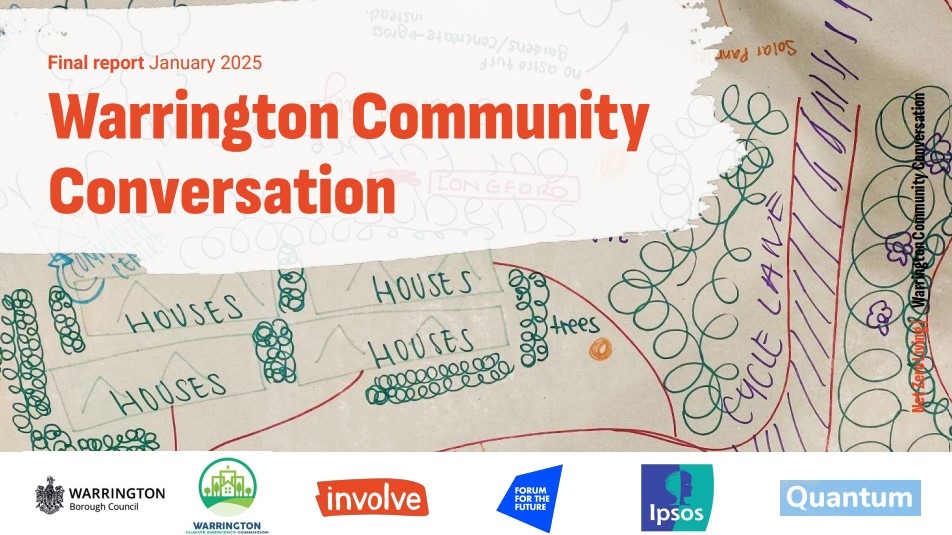
Warrington Community Conversation Report Cover. Source: Warrington Council.
Hopeful Future Report Cover. Source: King’s College London
How you can get involved?
Up through January 2027, there is still a chance to shape the strategy for the project through sharing your thoughts. If you have more thoughts about how these projects, or similar ones, could help support our Vision, share them via:
- Email: admin@efht.org.uk
- Call us on: 020 85089061
- We are also developing an interactive digital platform to collect thoughts and responses. Watch this space!
If you would like to play even more of a part in shaping and delivering the project, get in touch with us about volunteering opportunities.
The survey and events will start being held from late winter/early spring 2027, so keep an ear to the ground!
You may also be interested in

A People's Vision for the People's Forest
Find out more about the “future thinking” exercise where we will ask local communities to imagine and discuss hopes and concerns for what Epping Forest will be like in 2078: the 200th anniversary of the Epping Forest Act.

Volunteer with us
Whatever your skills or background, however much time you can give, you can make a difference.
People's Forest Panel
Bring together local people to help shape our advocacy work on behalf of the Forest. Part of the ‘Epping Forest Together’ project funded by The National Lottery Community Fund.