
by Abi Young, EFHT Trustee, Environmental Educator at The Hive (formerly Suntrap)
Climate change is the long-term shift in the Earth’s temperatures and weather patterns. This is a natural occurrence, however human activity has quickly become the main cause of climate change, largely due to the burning of fossil fuels for energy. This, alongside other human activities, produce greenhouse gas emissions which get trapped in our atmosphere, acting as a blanket that traps the sun’s heat, causing our planet to get warmer. The more emissions, the thicker the blanket, and the greater the amount of warming.
One of the greatest threats Epping Forest now faces is Climate Change
Higher summer temperatures and reduced rainfall result in drier, more compacted ground, increasing the risk of drought, and in turn increasing the likelihood and severity of forest fires as there is more dry material (fuel) on the forest floor. Conversely, drought and compaction can prevent rainfall from soaking into the ground, increasing surface runoff and the risk of localised flooding. Visitors avoiding surface water by venturing off-path could damage the understory of the forest through trampling and compaction, leading to more flooding via a vicious feedback loop. Rising temperatures can also increase the risk of pathogens and disease. For example, the invasive Oak Processionary Moth caterpillars are expanding their range as they favour warmer temperatures.
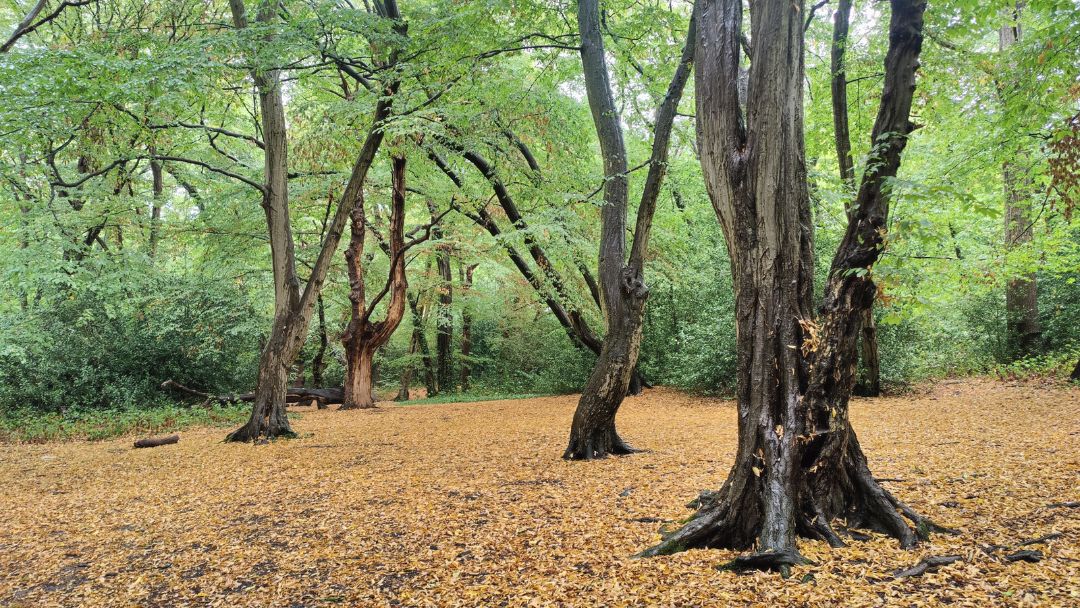
Four heartwaves in 2025 resulted in a ‘false autumn’, where lack of rain pushed trees into survival mode by turning into autumn colours and shedding their laves as early as August.
Hotter, drier summers and warmer, wetter winters are a direct result of human induced climate change, and we can see how this is impacting the forest and the communities around it.
Accelerated Climate Change is also responsible for affecting global wind patterns, of which we feel locally through more frequent and intense storms that bring stronger wind speeds, causing tree collapse and damage to people, infrastructure and habitats. Damage is even more pronounced when these windfall events occur while trees are still in leaf.
Plans for 68,000 new homes around the Forest over the next 15 years will exacerbate these problems through increased carbon emissions and pollution from vehicular traffic, and damage to the Forest through increased footfall.
Protect the Forest for generations to come
Epping Forest is home to 55,000 ancient trees, which have been shaped by countless generations over thousands of years, and support a variety of plants, fungi and animal species, many of which are rare elsewhere. It is vital that we optimise our contribution to tackling climate change so that we can protect this magnificent Forest, and all who depend on it, for generations to come.
Notes:
This article is first published on Trust in the Forest members’ magazine, Spring 2026 issue (no 22).
Find out more

'Epping Forest Together' Project
Funded by The National Lottery Community Fund, this three-year project aims to engage and enable communities to conenct with nature and to come together to make a positive environmental impact in this ancient Forest.

Help conserve Epping Forest
Join our Conservation Officer for a day and carry out hands-on woodland conservation activities to help improve biodiversity of the Forest.

Become a member
Demonstrate your love for the Forest and join EFHT as a member, and help preserve and protect Epping Forest and its irreplaceable biodiversity, culture and heritage now and for generations to come.